
Birth and Hidden Preservation
Zeus’ story begins with concealment, a narrative that reveals the precarious balance between destiny and fear. Cronus, ruler of the Titans, consumed each of his children at birth to avoid the prophecy of overthrow. Hestia, Demeter, Hera, Hades, and Poseidon disappeared into his stomach. Only the cunning of Rhea spared Zeus. On the island of Crete she bore him in secrecy. A stone wrapped in swaddling cloths tricked Cronus, while the infant was hidden in a cave, fed by the goat Amalthea, and protected by the Curetes, warriors who clashed their weapons to mask his cries.
The hidden infancy of Zeus provides an archetypal pattern. True authority often germinates unseen. Greatness is not immediate display but careful preparation, concealed until conditions demand revelation. The student of this grimoire should recognize that sovereignty may begin in secrecy, nurtured quietly until its moment arrives.
The Titanomachy and the Ascent of Power
When Zeus reached maturity, the prophecy reawakened. He confronted Cronus and forced the disgorgement of his siblings. Freed, they aligned with him. Together they declared war on the Titans, the elder order resistant to change. For ten years the conflict raged, shaking heaven and earth. The outcome shifted when Zeus released the Cyclopes, who forged for him the thunderbolt, and the Hecatoncheires, the hundred-handed giants who hurled mountains against their foes. With these allies the Olympians prevailed, and the Titans were cast into Tartarus, confined beneath the earth.
This narrative is not mythic spectacle alone; it is political allegory. Zeus’ victory was secured not by solitary might but by alliance, strategic release of neglected allies, and the weapon of lightning—clarity itself. For the initiate, the Titanomachy is the reminder that inner and outer battles are won through coalition, timing, and the capacity to endure long struggle.
Division of the Cosmos
After victory, the universe required order. By casting lots, Zeus’ brothers received realms: Poseidon the sea, Hades the underworld, and Zeus the sky. Yet his role exceeded atmospheric phenomena. Zeus was enthroned as the sovereign of gods and men, arbiter of justice, protector of oaths, and enforcer of hospitality. The sky is not only weather but the overarching vault, the dome beneath which all beings live. To hold the sky is to hold the principle that encompasses all domains.
In this cosmic distribution the initiate learns hierarchy. Leadership is not the possession of all but the capacity to hold center. Zeus’ reign demonstrates that sovereignty is both a realm and a principle. He governs not because he owns every corner but because his authority frames them all.
Symbols and Emblems of Authority
The Thunderbolt
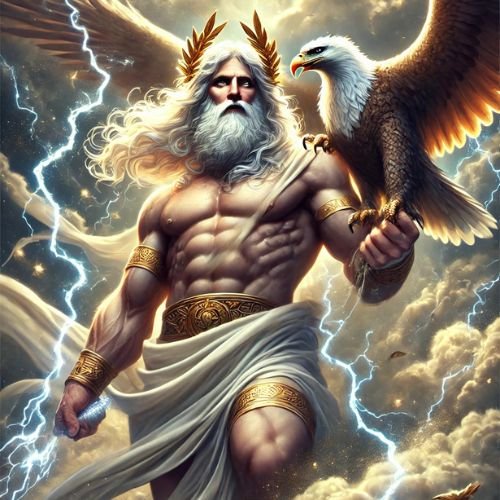
The thunderbolt forged by the Cyclopes is Zeus’ most defining emblem. It is sudden, decisive, and irresistible. Symbolically, it is judgment that cannot be ignored, clarity that pierces confusion, and intervention that restores order. For students, the thunderbolt represents the ability to act decisively when hesitation paralyzes.
The Eagle
The eagle soars above storms, embodying vision and surveillance. It is the herald of height, a bird that looks beyond immediate circumstance. Roman standards bore the eagle as extension of Zeus’ symbol into imperial imagery. For initiates, the eagle is the practice of perspective—seeing the whole field before striking.
The Oak
At Dodona, Zeus’ oracle spoke through the rustling of oak leaves. The oak is rooted endurance, stability across centuries, and capacity to withstand storms. To meditate upon the oak is to seek resilience, to recognize that authority is long growth, not brief eruption.
The Aegis
The aegis, shield fringed with serpents, radiates terror to adversaries and protection to allies. Though often depicted with Athena, it is Zeus’ property. It signifies the aura of presence that defends without striking, the invisible circumference of dignity. In practice, it teaches that sometimes authority persuades not by action but by unmistakable presence.
Zeus in Ethical Dimension
Zeus’ authority extends into ethics. In cult he bore epithets that anchored civic life: Zeus Xenios, guardian of strangers and hospitality; Zeus Horkios, protector of oaths; Zeus Polieus, guardian of the polis. These roles emphasize accountability. Zeus punishes oath-breakers, defends the weak, and ensures reciprocity in human affairs. Authority in his name is not license; it is burden. Sovereignty requires justice.
For initiates, this means aligning with integrity. Power divorced from fairness collapses into tyranny. Zeus’ mythology, though filled with passion and conflict, still anchors a principle: law binds ruler as much as subject.
Zeus in Relationship
With Hera
Hera, queen and consort, represents both complement and challenge. Their marriage symbolizes legitimacy of rulership but also tension, jealousy, and endurance. The student must recognize that leadership is tested not only by enemies but by those closest.
With Athena
Athena sprang fully armed from the head of Zeus, symbolizing wisdom issuing from sovereignty. Their relationship demonstrates that rulership requires counsel, intelligence, and strategy. Zeus without Athena would be force without guidance; Athena without Zeus would be wisdom without authority.
With Prometheus
Prometheus’ theft of fire and gift to humanity defined a boundary. Zeus punished him, enforcing divine order. Yet humanity gained culture from the transgression. This tension reveals that sovereignty sometimes resists innovation, yet innovation still reshapes order. The initiate must learn to balance boundaries with adaptation.
With Mortals
Zeus descends in countless myths, shaping destinies, testing hospitality, and fathering lineages. His presence affirms that divine sovereignty is not remote abstraction. It intersects with human life, guiding and correcting. For students, the lesson is that rulership touches daily existence; order is tested in ordinary exchanges.
Archetypal Interpretation
Archetypally, Zeus represents the sovereign principle. His symbols translate into psychological realities: thunderbolt as decisive clarity, eagle as vision, oak as endurance, aegis as protective presence. To embody Zeus is to stand at the point where decision must be made, to balance justice with authority, and to radiate presence that orders without excessive display.
Authority must be tempered. The myths remind us that Zeus can be volatile, susceptible to passion, and challenged by rebellion. The archetype therefore is not perfection but dynamic balance. To embody Zeus is not to imitate flawlessness but to accept the challenge of ruling amidst complexity.
Cultic Worship and Local Variants
Zeus’ worship spanned the Greek world, each city emphasizing facets of his sovereignty. At Olympia he received sacrifice during the games, embodying excellence and athletic honor. At Dodona his voice spoke through oak and dove, embodying oracular wisdom. At Athens he bore civic titles, embodying political order. These variations show that sovereignty adapts to context. For initiates, it is reminder that rulership must be specific: authority must serve the community in front of you, not only abstract princip…
Cult titles, or epithets, reveal dimension: Zeus Keraunios, the Thunderer; Zeus Panhellenios, uniting all Greeks; Zeus Chthonios, connected to the earth. Each epithet is a key to a facet of his nature. The grimoire recognizes these as doorways, each opening to a different current of the Sky-Father’s presence.
Additional Analysis: Zeus as Legal and Cosmic Arbiter
Beyond the narratives of myth, Zeus functions as the archetypal judge. Ancient inscriptions invoke him in contracts, treaties, and civic oaths. His role was not metaphorical; his name was legally binding. To swear by Zeus was to place one’s word under cosmic surveillance. The modern initiate should read this as reminder: authority requires verifiable speech. Promises must be measurable, actions accountable, and justice visible. Zeus does not tolerate hidden duplicity. His thunder strikes falsehood not alone but as cosmic rebalancing.
Equally significant is Zeus’ role in maintaining cosmic rhythm. The succession myth—Uranus dethroned by Cronus, Cronus dethroned by Zeus—teaches that power is cyclical. Yet Zeus breaks the cycle by stabilizing order. Where his predecessors fell to the next generation, Zeus endures. The archetype here is consolidation. Initiates are urged to consolidate gains, not merely seize them. Establish rhythm, institution, and law so that what you build can last beyond the moment of conquest.
Additional Cultic Context
Archaeology reveals altars to Zeus in mountains, open-air sanctuaries, and civic centers. The high places symbolized his rule over sky and weather; the civic altars symbolized his governance of law and assembly. Both are relevant for practice. The initiate may honor Zeus beneath open sky to seek expansive vision, or within civic structures to align leadership with justice. Each site corresponds to a dimension of his power. High sanctuaries cultivate vision; civic sanctuaries cultivate responsibility. Learn to balance both.
The Olympic festival is a striking example. Athletes competed not merely for honor but under oath to Zeus. To violate rules was to insult the god himself. This union of excellence, discipline, and sacred accountability embodies Zeus’ ethic. For modern students, excellence pursued without justice is hollow; justice pursued without excellence is weak. The union of both forms sovereignty.
Reflections for the Student
-
Where in your life are you concealed, preparing for emergence?
-
What inner Titans resist the order you seek to establish?
-
Which alliances could strengthen your cause as the Cyclopes and Hecatoncheires strengthened Zeus?
-
Where must you wield thunderbolt clarity, eagle vision, oak endurance, or aegis presence?
-
How will you ensure that your authority serves justice rather than domination?
Reflection transforms myth into mirror. Without reflection, stories remain external; with reflection, they become internal law.
Concluding Perspective
Zeus, then, is more than mythic ruler. He is axis of sky and society, arbiter of law and hospitality, emblem of power tempered by order. His myths teach survival, struggle, and triumph. His symbols instruct vision, clarity, endurance, and presence. His cult reveals adaptation to local need. His archetype guides leaders inward and outward.
The initiate who studies Zeus is invited not merely to admire the thunder but to embody its lessons: hidden preparation, decisive clarity, resilient endurance, protective presence, and enduring justice. This lesson therefore establishes the foundation. Zeus is the model of sovereignty, the standard of order, and the living archetype of responsibility. To study him is to confront power in its complexity. To honor him is to choose justice over tyranny. To invoke him is to accept the burden of leadership.
Transition Forward
The next lesson will turn to Zeus’ powers in detail. These powers are active currents—lightning, weather, strength, immortality, and justice. To understand them is to gain not only mythic knowledge but living tools. Prepare to engage each power with respect and precision, for they are the instruments through which Zeus orders the cosmos and through which you may order your own life.